
Fredericksburg TX Vacation Rental Management Explained

Fredericksburg TX vacation rental management is the practice of overseeing a short-term rental property's pricing, guest communication, housekeeping, maintenance, and regulatory compliance on behalf of an owner, either as a full-service arrangement or a hybrid co-hosting model. At Stay In The Heart of Texas, we've spent years managing cabins and cottages across Fredericksburg's Main Street corridor and the surrounding Hill Country, and the question we hear most from owners isn't "should I hire someone," it's "what am I actually paying for, and is it worth it." This guide answers that directly.
Key Takeaways
Fredericksburg had 3,316 active short-term rental listings as of May 2026, with supply up 7.2% year over year, according to AirDNA.
Full-service vacation rental management in Fredericksburg typically costs 10% to 35% of gross bookings, depending on scope, while stripped-down or AI-based services can run closer to 3.9% to 15%.
Average daily rate in Fredericksburg sits near $334 to $336, with peak occupancy around 45% to 51% in March, per AirDNA and GetChalet data.
Short-term rentals must collect and remit a combined 13% hotel occupancy tax (7% city, 6% state) in Fredericksburg, and owners must register and pass an annual inspection to hold a local permit.
Top-quartile professionally managed properties in the Fredericksburg market can reach 70% or higher occupancy, compared to a median closer to 36%, according to AirROI.
Fredericksburg's inventory is dominated by entire-home listings (about 93.8%), so competing on amenities and presentation, not just price, is what separates top performers.
If you own a cabin, cottage, or converted barn in Fredericksburg and you're weighing whether to keep self-managing or bring in a professional team, you're not alone. The Hill Country's short-term rental market has grown fast, and with growth comes more competition for guest attention. In 2026, the owners doing well aren't necessarily the ones with the newest property, they're the ones with the sharpest pricing strategy, the cleanest compliance record, and a team that answers guest messages at 11pm on a Friday.
This article breaks down what vacation rental management actually includes in Fredericksburg, what it costs, how local boutique operators compare to national franchises, how seasonal events like Oktoberfest and Wine Road 290 traffic move pricing, and how to vet a manager before signing anything. We'll also walk through the onboarding process step by step, something most competitor content skips entirely.
What Does Vacation Rental Management Actually Include in Fredericksburg?
Vacation rental management in Fredericksburg refers to the outsourced operational work of running a short-term rental, covering everything from listing creation to guest checkout. Specifically, full-service management usually bundles together six core functions: listing optimization across platforms like Airbnb and VRBO, dynamic pricing, 24/7 guest communication, housekeeping coordination, maintenance support, and hotel occupancy tax handling.
Most Fredericksburg managers, including Stay In The Heart of Texas, also handle monthly financial reporting and starter-supply restocking (coffee, paper goods, soap) between stays. As a result, an owner's day-to-day involvement drops close to zero once onboarding is complete.
What full-service management does not typically cover is just as important. Capital improvements, HOA disputes, storage of personal belongings, and structural work like roof replacement or HVAC overhauls generally fall outside a management contract. If your Fredericksburg cabin needs a new roof, that's a separate conversation with your manager, not something baked into the monthly fee.
From what we see across our own portfolio, which spans historic Main Street cottages like Musik Haus to larger group cabins on wooded acreage, the properties that perform best are the ones where the manager treats compliance and guest experience as equally important, not an afterthought bolted onto pricing software.

How Much Does Fredericksburg Vacation Rental Management Cost?
Fredericksburg vacation rental management fees generally range from 10% to 35% of gross bookings, depending on how much of the operational workload the manager absorbs. Half-service providers, which typically exclude cleaning, restocking, and maintenance coordination, tend to charge on the lower end, around 10% to 15%. Full-service local operators and national brands sit higher, often 20% to 35%.
For context, AI-driven, low-touch platforms like TIDY advertise fees as low as 3.9% of gross bookings with a monthly minimum, but that model typically excludes hands-on guest support and local compliance handling. National brand Vacasa is commonly cited in the 25% to 35% range, while Casago tends to run closer to 18%. Local, owner-operated companies fall across that same spectrum but usually include more personalized service.
To put the numbers in perspective: at a median nightly rate near $175 and roughly 65% occupancy (a figure cited by TIDY's market data), a typical Fredericksburg vacation rental grosses somewhere around $41,000 a year. At a 25% management fee, that's about $10,250 annually spent on management, in exchange for not answering a single 2am guest text about the WiFi password.
Management Type | Typical Fee Range | What's Usually Included | What's Usually Excluded |
AI/low-touch platforms | 3.9% to 15% | Basic listing sync, pricing tools | Cleaning, guest support, compliance handling |
Half-service managers | 10% to 15% | Listing, pricing, some guest messaging | Cleaning, restocking, maintenance coordination |
Local full-service managers | 18% to 30% | Full operations, local presence, compliance help | Capital improvements, HOA disputes |
National franchise brands | 25% to 35% | Full operations, broad channel distribution | Local nuance, personalized service |
Notably, fee percentage alone doesn't tell the whole story. A 20% fee from a manager who consistently hits 60%+ occupancy can out-earn a 12% fee from a platform that leaves your calendar half empty. This is exactly why Stay In The Heart of Texas builds pricing around real Fredericksburg demand data instead of a flat percentage discount pitch.
Local Boutique Managers vs. National Brands: What's the Real Difference?
Choosing between a local boutique manager and a national franchise in Fredericksburg comes down to responsiveness, local market knowledge, and how much personalized attention your property receives. Local operators, including Stay Texas Hospitality Group (founded in 2013 and managing over 300 properties across the Hill Country) and FBG Lodging, which operates Gästehaus Schmidt and has served the area for roughly 35 years, tend to know which streets flood weekly during wine festival weekends and which neighborhoods have stricter noise complaint histories.
National brands like AvantStay or Vacasa bring broader channel distribution and standardized technology stacks, which can help with visibility on platforms beyond Airbnb. But standardization has a cost: a call to guest support often routes to someone in a different state who has never driven Wine Road 290 or dealt with a Gillespie County noise ordinance question firsthand.
This is a genuine content gap most competitor articles skip: the practical difference shows up in response time and local recommendation quality. When a guest at one of our Fredericksburg properties asks where to find live music on a Tuesday night, a locally based team can answer in one text. A call-center model usually can't.
Other locally rooted names in the market include Grand Welcome Texas Hill Country, which serves Fredericksburg alongside Dripping Springs and Wimberley, and Heavenly Hosts, a Super Host-led operation expanding into Blanco and Comfort. Each brings a slightly different mix of scale and personal touch, so it's worth asking any prospective manager how many Fredericksburg-specific properties they currently manage, not just their total portfolio size.
How Do Fredericksburg Events Affect Pricing and Occupancy?
Seasonal events in Fredericksburg materially shift both occupancy and nightly rates throughout the year. Wine Road 290 traffic, Oktoberfest, the Fredericksburg Trade Days, and the holiday markets each push demand well above baseline, and a manager who doesn't adjust pricing three to four weeks ahead of these dates is leaving money on the table.
According to AirDNA and GetChalet data, March consistently ranks as Fredericksburg's peak occupancy month, hitting around 51% with average daily rates near $324, driven largely by spring wildflower season and wine country travel. By contrast, deep winter and late summer months can drop occupancy closer to 30% to 33%.
Specifically, the gap between a static, "set it and forget it" pricing model and an actively managed one shows up most during shoulder-season weekends tied to events. AirROI data shows peak-season monthly revenue can top $5,350, while shoulder season averages closer to $4,180, and low season drops to about $2,870. Managing that swing well, rather than leaving rates flat all year, is one of the clearest ways professional management pays for itself.
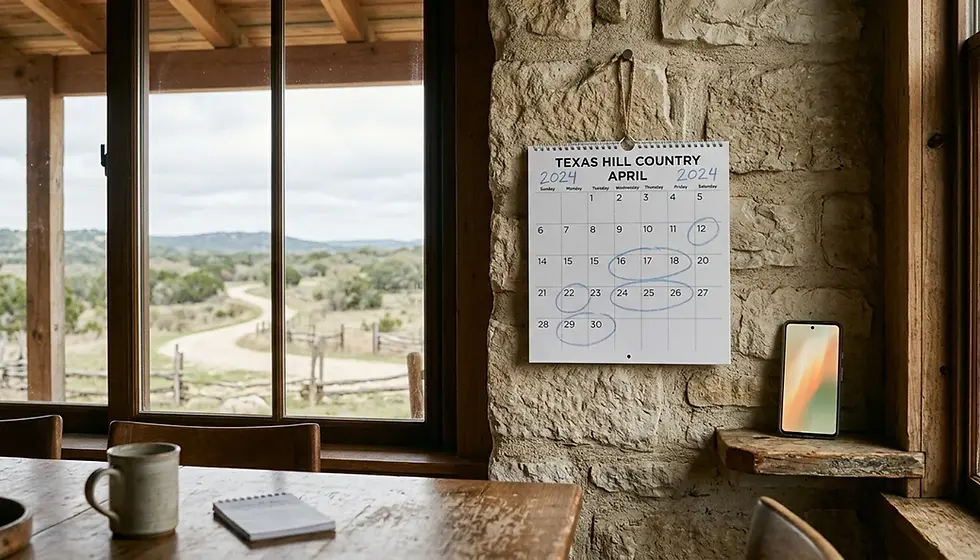
If you're weighing whether your property is capturing this seasonal upside, it's worth reviewing how bluebonnet season traffic near Fredericksburg typically drives March and April bookings, and cross-referencing that against your own calendar's historical rate adjustments.

What Permits and Taxes Apply to Fredericksburg Short-Term Rentals?
Short-term rental owners in Fredericksburg must register their property with the city, pass an annual inspection, and obtain a local operating permit before hosting guests. This registration process is separate from, and in addition to, any homeowners association rules that may apply to a specific neighborhood.
On the tax side, Fredericksburg short-term rentals must collect and remit a combined 13% hotel occupancy tax, split between a 7% city portion and a 6% state portion, on every guest payment. This applies whether you self-manage or use a third-party manager, though most full-service managers, including Stay In The Heart of Texas, handle the collection and remittance process as part of their standard scope.
Beyond the citywide requirements, Gillespie County ordinances may layer on additional rules around parking, signage, and waste management for specific properties. Because these requirements can change and vary by exact address, always confirm current permit and tax specifics directly with the City of Fredericksburg and Gillespie County offices, or ask your management company to walk you through the current requirements for your specific parcel.
As of 2026, Fredericksburg's overall regulatory posture is considered moderate to lenient compared to many other Texas cities, according to AirROI and Airbtics market analysis, which allows home-sharing in many residential zones while still requiring safety inspections and tax compliance.
What's the Step-by-Step Onboarding Process for a New Fredericksburg Rental?
Onboarding a new short-term rental in Fredericksburg follows a fairly predictable sequence, though few resources walk through it start to finish. Here's the process we use with new owners:
Zoning and HOA check: Confirm the property's zoning allows short-term rental use and review any HOA restrictions before investing in furnishings or marketing.
City registration and permit application: Submit your short-term rental registration with the City of Fredericksburg and schedule the required annual safety inspection.
Tax account setup: Establish your hotel occupancy tax remittance account for both the city (7%) and state (6%) portions before your first booking.
Listing build and photography: Create optimized listings on Airbnb, VRBO, and additional channels, with professional-quality photos that highlight what makes the property distinct.
Technology stack setup: Install smart locks, noise monitoring, and a channel manager to sync calendars across platforms and prevent double bookings.
Pricing strategy launch: Set baseline rates using local comparable data, then layer in event-based pricing adjustments for known Fredericksburg demand spikes.
First guest walkthrough: Run a soft-launch stay, ideally with a friend or family member, to test check-in flow, WiFi, and instructions before the first paying guest arrives.
Skipping the zoning check is the most common mistake we see among first-time hosts. Owners sometimes furnish an entire cabin before confirming the property even qualifies for short-term rental use, which is an expensive way to learn about a restriction.
How Do You Vet a Vacation Rental Manager in Fredericksburg?
Vetting a vacation rental manager means evaluating their local presence, fee transparency, technology stack, and guest review reputation before signing a contract. Ask directly how many Fredericksburg properties they currently manage, not their total portfolio across every market they serve.
Specifically, request three things before committing: a sample monthly report showing revenue and occupancy data, a clear breakdown of what the management fee does and doesn't cover, and references from at least two current property owners in the Hill Country area. A manager who hesitates on any of these three requests is a red flag.
Additionally, ask how they handle compliance with Gillespie County ordinances and Fredericksburg's registration requirements. A manager who can't clearly explain the current permit and tax process likely isn't deeply embedded in the local market, regardless of how polished their sales pitch sounds.
Contract red flags to watch for include auto-renewing terms with no easy exit clause, vague language around what counts as a "maintenance" versus "capital improvement" expense, and fee structures that change after the first few months. A transparent manager puts all of this in writing upfront.
Full Management vs. Co-Hosting: Which Model Fits Your Property?
Co-hosting is a hybrid management model where the owner retains partial control and involvement while outsourcing specific tasks like guest messaging, turnovers, or emergency coverage. It works well for second-home owners in Fredericksburg who want to stay hands-on but need backup during busy weekends or personal travel.
Full-service management, by contrast, hands over nearly the entire operation, listing, pricing, cleaning, maintenance, and compliance, to the management company. This suits out-of-state cabin owners and busy investors who want to reclaim their time entirely rather than manage a task list from a distance.
There's little published guidance comparing these two models specifically for Fredericksburg, which is a gap worth addressing directly: if you enjoy the hospitality side, want to personally greet returning guests, or have strong opinions about interior styling, co-hosting lets you retain that control while still getting help with the exhausting parts, turnovers and 2am messages. If you just want the revenue without the workload, full-service is the better fit.
At Stay In The Heart of Texas, we offer both models because we've seen firsthand that the "right" answer depends entirely on how much involvement an owner actually wants, not on which option sounds more professional.

How Does Fredericksburg's STR Market Compare to Nearby Hill Country Towns?
Fredericksburg's short-term rental market is defined by its entire-home dominance, with roughly 93.8% of listings being whole properties rather than shared rooms, and a market composition that skews toward 1 and 2-bedroom cabins (49% and 21% of listings respectively), according to AirDNA. This makes it a strong market for couples and small families, though larger group cabins like the Fredericksburg Log Cabin, which sleeps up to 18 guests, can command premium rates precisely because that inventory is scarcer.
Compared to New Braunfels, which draws heavier tubing and Schlitterbahn-driven summer traffic, Fredericksburg's demand is more spread across the calendar thanks to wine tourism, Oktoberfest, and wildflower season. As a result, Fredericksburg owners who diversify amenities, hot tubs, fire pits, game rooms, tend to smooth out the seasonal dips better than properties relying purely on location.
Annual gross yield on Fredericksburg STR investments averages around 9.17% of property value, with some submarkets reaching as high as 15%, according to Chalet's 2026 investor data. That's a meaningfully strong return compared to many long-term rental markets, though it depends heavily on maintaining occupancy above the market median through active pricing and marketing, not passive listing.
Practical Guidance: Common Mistakes Fredericksburg Owners Make
The most common mistake among self-managing Fredericksburg owners is static pricing, leaving nightly rates flat regardless of upcoming wine festivals, Oktoberfest, or holiday markets. A close second is neglecting the annual safety inspection deadline, which can result in an owner losing their permit mid-season.
Here's a quick checklist worth reviewing before your next guest arrives:
Confirm your hotel occupancy tax account is active and remittances are current with both city and state.
Adjust pricing at least three to four weeks ahead of known Fredericksburg events.
Verify your listing is distributed across more than just Airbnb, ideally including VRBO and a direct booking option.
Review guest communication response times; anything slower than an hour during peak season risks a lower review score.
Schedule your annual city inspection well before renewal deadlines to avoid a lapse in your operating permit.
Owners who treat these five items as recurring habits, not one-time setup tasks, consistently outperform those who set up their listing once and never revisit it.
Frequently Asked Questions
How much does it cost to hire a property manager in Fredericksburg?
Fredericksburg property management fees typically range from 10% to 35% of gross bookings depending on scope. Full-service local management, which includes cleaning, guest communication, and compliance handling, generally falls between 18% and 30%, while stripped-down platforms can charge under 15%.
What's the difference between co-hosting and full-service management?
Co-hosting is a hybrid model where the owner stays involved and outsources specific tasks like turnovers or guest messaging, while full-service management hands over nearly all operations, including pricing, compliance, and maintenance coordination, to the manager.
Do I need a special permit to run a short-term rental in Fredericksburg?
Yes. Fredericksburg requires short-term rental owners to register with the city, pass an annual safety inspection, and hold a valid local operating permit. Confirm current requirements directly with the City of Fredericksburg, since specifics can change.
How do I collect and remit hotel occupancy tax on my Fredericksburg rental?
Fredericksburg short-term rentals must collect a combined 13% hotel occupancy tax, split between a 7% city portion and a 6% state portion, on guest payments. Most full-service managers handle this remittance process as part of their standard services.
Is Fredericksburg still a good market for a short-term rental investment in 2026?
Fredericksburg remains a strong STR market in 2026, with average annual gross yields around 9.17% of property value and average daily rates near $334, according to Chalet and AirDNA data. Growing supply (up 7.2% year over year) means competition is rising, so amenity quality and pricing strategy matter more than ever.
Which OTA platforms should I list my Fredericksburg rental on besides Airbnb?
Beyond Airbnb, most Fredericksburg managers recommend listing on VRBO and Booking.com at minimum, with some operators distributing across 20 to 50 additional channels. Broader distribution reduces reliance on a single platform's algorithm and search visibility.
How do I know if my Fredericksburg nightly rate is competitive?
Compare your rate against the current market average daily rate, roughly $334 to $336 as of 2026, adjusted for your property's bedroom count, amenities, and proximity to Main Street. Properties priced well below market often signal underperformance in listing quality, not just price sensitivity.
Conclusion: Making Sense of Fredericksburg Vacation Rental Management
Fredericksburg TX vacation rental management, at its core, comes down to three levers: pricing that responds to real seasonal demand, compliance that stays current with city and county rules, and guest communication that doesn't require your evenings and weekends. With average daily rates near $334 and top-quartile occupancy reaching 70% or higher, the gap between a passively managed property and an actively managed one is significant.
Whether you're a burned-out self-manager ready to hand off the workload, an out-of-state owner who needs local eyes on the property, or a first-time host still setting up your permit and tax accounts, the path forward starts with an honest look at how much time and revenue your current approach is actually costing you. As we move further into 2026, Fredericksburg's growing supply means the owners who invest in real management, not just a listing on autopilot, will be the ones who keep their calendars full.

If self-managing your Fredericksburg property is starting to feel unsustainable, or you're simply not sure whether your pricing and compliance setup is where it should be, Stay In The Heart of Texas can walk you through what full-service or co-hosting support would look like for your specific property. Reach out anytime to start the conversation.
Written by Rashmi Bhat, Owner & Operator at Stay In The Heart of Texas

Comments